

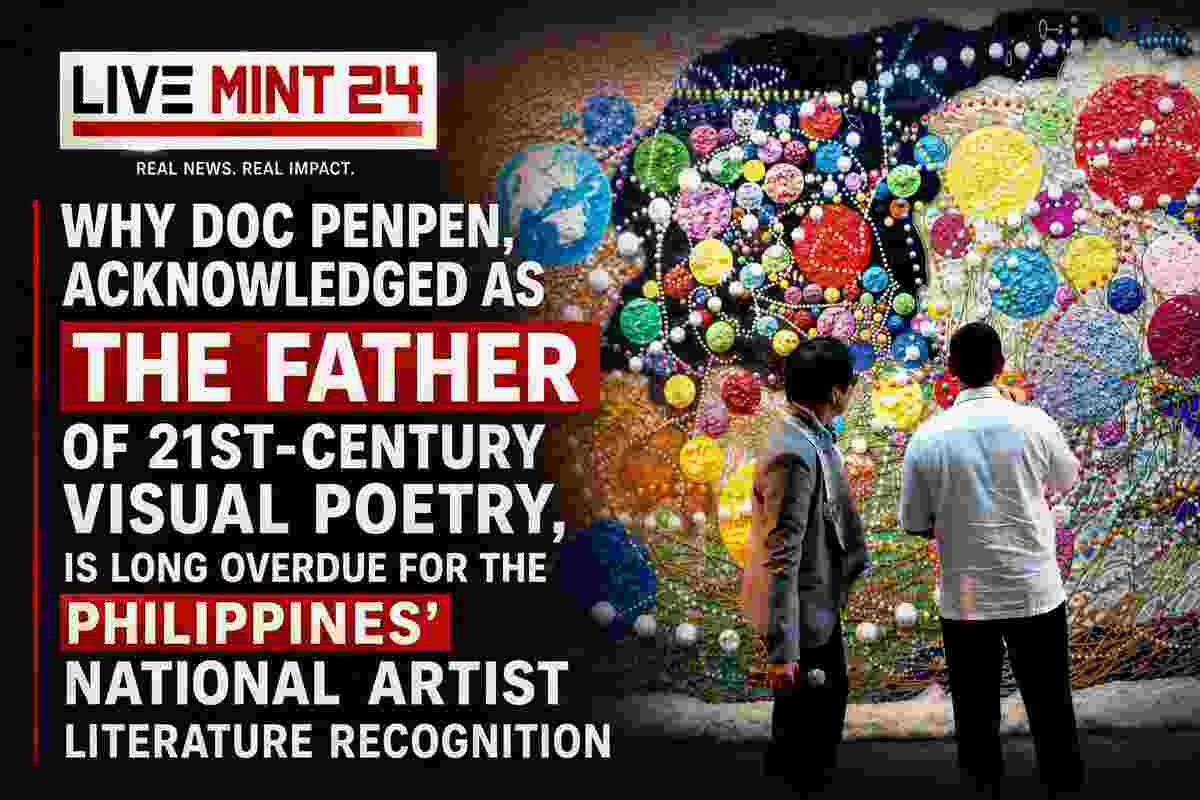
By Professor Jose Laderas Santos (Joe Lad Santos)
Surpassing the Pioneers: A Comparative Analysis of Doc PenPen’s Visual Poetry and Early Practitioners
Visual poetry, an art form where the arrangement of words, letters, symbols, typography, color, and multimedia elements creates visual images to enhance or convey meaning, has roots in ancient Technopaegnia and has evolved through modern Concrete Poetry into a dynamic, global genre. Dr. Epitacio Ramos Tongohan, known as Doc PenPen Bugtong Takipsilim—a Filipino medical doctor, pathologist, and founder of the Pentasi B World Friendship Poetry® movement—has revolutionized this field. Internationally acclaimed as the “Father and King of Visual Poetry,” his work integrates science, philosophy, and aesthetics into a “neo-genre” that is multilingual, multimodal, multiangular, multisensorial, and multidimensional (the 5Ms of Pentasi B).
This analysis compares Doc PenPen with five foundational visual poets—Simmias of Rhodes, George Herbert, Guillaume Apollinaire, Jose Garcia Villa, and e.e. cummings—explaining why he surpasses them and has earned titles they did not. It also traverses and plumbs the depths of Professor Rogelio L. Ordoñez’ assessment that Doc PenPen’s poem “oo. sa mga retaso” outshines Villa’s comma poems, emphasizing the “therapeunigmatic” (ℎ , ℎ ℎ , , ℎℎ ℎ ) and “liberamorphic” ( ℎ, ) significance of his contributions.
Furthermore, drawing from endorsements by cultural luminaries like Former National Library Director Antonio M. Santos and Prof. Jose Laderas Santos, this essay builds a case for why Doc PenPen’s nomination as a National Artist for Literature is “long overdue,” adding credibility through his global impact, charitable works, and transformative power.
Doc PenPen’s Key Contributions to Visual Poetry
Doc PenPen’s Pentasi B poetry—standing for , – , , , , , , —blends medical precision with artistic innovation. Poems like yes !am (exploring boundless divine love) and But Up) (on resilience after Typhoon Ondoy) are therapeunigmatic, evoking healing by shifting negative thoughts to positivity, as seen in testimonies where his work prevented suicides and transformed vice-dependent individuals (.., ). Its liberamorphic nature democratizes poetry, breaking barriers of grammar, syntax, rhyme, and elitism, allowing “diverse voices to find expression” and fulfilling a vision of “… ,…..”
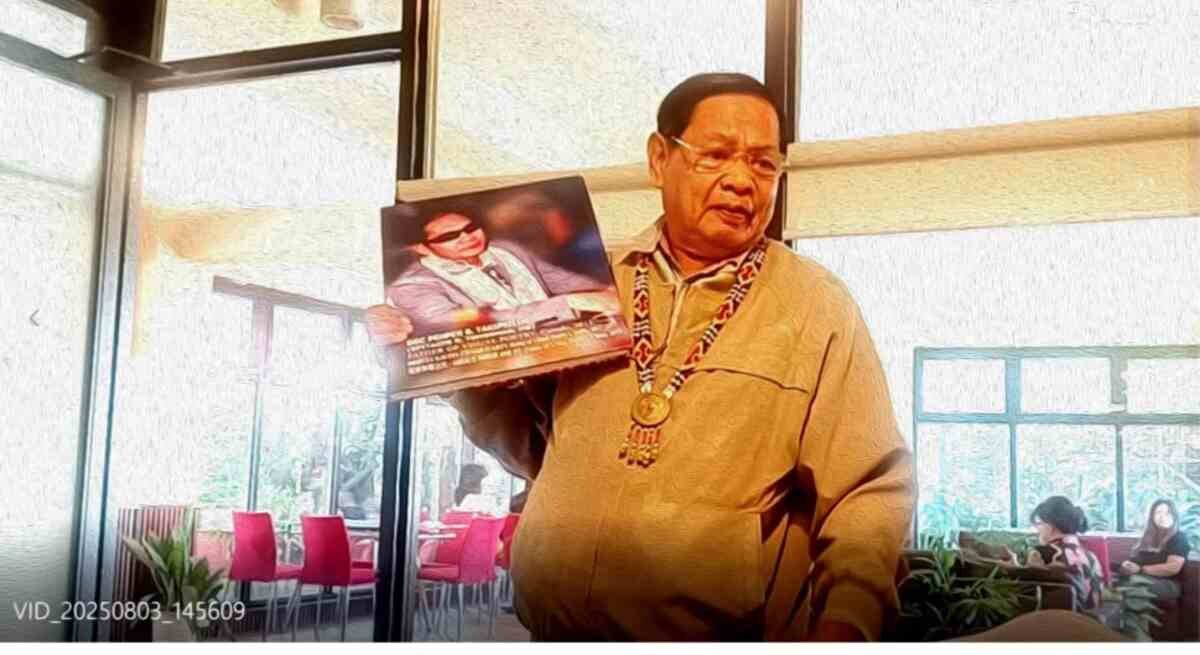
- Global Reach and Charity: He founded one of the world’s largest poetry groups, rallying poets from the Philippines to Antarctica. His three-volume Pentasi B anthologies were donated to libraries in over eight countries (e.g., National Library of China in 2019, University of British Columbia in 2012), with one set auctioned for $30,000 in the U.S. (2012) to fund education for underprivileged students.
- Healing and Unity: Rooted in humanistic transcendentalism, his poetry promotes global harmony, aligning with prophecies like William Shakespeare’s and Jose Rizal’s visions for Philippine literary prominence, positioning the country as the “Poetry Heart of the World.”
Why He is Recognized as the Father of Visual Poetry in the 21st Century
Doc PenPen’s titles—“Father and King of Visual Poetry,” “Driisya Kavita Chakravarty” (India), “Shijue Shige zhi Fu” (China), “Görsel Şiir Babası” (Turkey), “Il Padre Della Poesia Visuale” (Italy), and “Anyuinsem Agya” (Ghana)—were conferred by international poets and institutions from 2011 onward:
- 2011: “Father of Philippine Visual Poetry” in the Philippines;
- 2012: “Father of Visual Poetry” in British Columbia, Canada;
- 2013: “Father of Visual Poetry” by the National Library of the Philippines;
- 2014: Görsel Şiir Babası in Turkey;
- 2015: Recognized as “Father of Visual Poetry” at Enverga University, Lucena City, Quezon, Philippines;
- 2016: “Anyuinsem Agya” in Ghana;
- 2016: “Il Padre Della Poesia Visuale” in Italy;
- 2017: “Driisya Kavita Chakravarty” (King of Visual Poetry) in India;
- 2018: “King of Kings of Visionary Poetry” by International Humanity Conference, Ghana, Africa;
- 2019: Recognized as “Padre de la Poesía Visual” during its Recognition and Honors Program in Mexico;
- 2019: “Shijue Shige zhi Fu” Sophy Chen World Poetry Award presented by Gao Jianbin, Director of the International School for Foreign Languages at the Xi’an Hotel in China;
- 2020: Literary Excellence at Par With Global Standards, India;
- 2021: Literary Luminaries Award from School of Arts and Poetry;
- 2022: “Robert Burns International Literary Prize” (Scotland – USA);
- 2023: “Honorary Diploma For Contribution to World Culture” Russia, Nizhny Novgorod;
- 2023: Father of Visual Poetry – Iconic Pinoy Mahalika, Dubai;
- 2024: Master Epitacio Tongohan Recognition for Society Literacy and Humanity, Puerto Rico;
- 2024: Asia’s Most Esteemed and Most Beloved Visual Poet of The Year, Philippines;
- 2024: Tanay Municipal Council (Sangguniang Bayan) Resolution Number 43, nominating Doc PenPen to the Order of National Artists for Literature (Poetry) and conferring on him the title Father and King of Visual Poetry, Philippines;
- and from Europe, North Africa, Central Asia, and South America — including Kosovo, Uzbekistan, Tunisia, Morocco, Kazakhstan, Kyrgyzstan, Bolivia, and Puerto Rico, among others.
These honors stem from his role in defining visual poetry as a living, interactive force, unlike the static forms of his predecessors. His therapeunigmatic and liberamorphic innovations empower audiences, making poetry a tool for personal and societal transformation.
BEYOND THE CANON: THE WISDOM OF DR. LILY ROSE TOPE ON DOC PENPEN, FATHER OF VISUAL POETRY
Dr. Lily Rose Tope, a respected scholar of Comparative Literature and professor at the University of the Philippines, delivered a pivotal critique at the 2013 Pentasi B Historical Forum, sponsored by the National Library and the National Museum of the Philippines, under the leadership of former Director Atty. Antonio M. Santos. Her words directly confronted the dominance of the literary CANON and elevated the people’s voice in honoring poets like Doc PenPen.
She began by exposing the nature of the Canon:
“… , , . ‘ . , , — . , , , ‘ ‘.”
(“…Now, the problem with the CANON is that they do not consult the masses, the readers. Whoever they want, whoever they are, whoever they have decided is excellent, that’s it.”)
Dr. Tope stressed that the CANON decides value without consulting the true lifeblood of literature: the readers. Against this exclusionary system, she pointed to the alternative offered by Pentasi B:
“ ‘ … . [ ] ‘ . , . !”
For Dr. Tope, Doc PenPen’s recognition does not—and should not—depend on Palanca Awards, NCCA, or CCP. It arises from the people who read and experience his work.
“ , … , , . .”
This was her firm stand: literary greatness is not dictated by institutions, but by the community of readers who find truth and innovation in the poet’s creations.
She underlined the deeper meaning of the title “Ama” (Father) given to Doc PenPen:
“, ‘’ , , , , , . , , , , , ‘. ‘ ‘,’ ‘, , , .”
In that declaration, Dr. Tope affirmed both the legitimacy and significance of Doc PenPen’s title as Father of Visual Poetry—a recognition grounded not in canonized hierarchies, but in authentic reception and appreciation by people across nations.

Her critique of the CANON and her acknowledgment of Doc PenPen stand as one of the most powerful affirmations of grassroots literary validation: a call to honor originality, creativity, and genuine impact over institutional gatekeeping.
A Narrative Synthesis: Rizal and Doc PenPen on the Value and Horizons of Language
“Ang magmahal ng sariling wika ay maganda
Ngunit ang mag-aral ng iba’t-iba pang wika
ay higit na maganda at kapaki-pakinabang sa modernong panahon
Ngunit ang tumuklas at mag-imbento ng mga bagong wika
o mga lengwaheng pangkalawakan ay natutulad
sa Mabango at Malayang Pilipinong Isda.”
— Doc PenPen, 2008
“Ang hindi marunong magmahal sa sariling wika, masahol pa sa hayop at malansang isda.”
— Dr. José Rizal, 1889 (attributed)
Dr. José Rizal’s oft-cited dictum has for more than a century stood as a cornerstone of Filipino identity: the love of one’s native tongue is indispensable to dignity and humanity itself. His image of one who neglects their language being “worse than an animal and a stinking fish” is deliberately jarring, crafted to awaken a colonized people to the moral and cultural necessity of cherishing their own speech. It is a saying that is powerful in its singularity and national focus, embedding language at the very heart of nationhood.
Doc PenPen’s 2008 reflection, however, begins from the same acknowledgment—that love for one’s native language is beautiful—but boldly expands the horizon of linguistic responsibility. For him, true vitality lies not only in treasuring one’s mother tongue, but in embracing multilingualism and the opportunities it offers in a globalized and technologically driven world. More radically still, he imagines the invention of entirely new languages, even those designed for cosmic, interplanetary communication with alien civilizations. In this vision, language becomes not only a cultural artifact but a bridge toward uncharted worlds, an evolutionary leap that celebrates creativity, adaptability, and boundless discovery.
Placed side by side, the sayings illuminate two complementary but distinct philosophies.
Rizal speaks from the urgency of the nineteenth century, where colonized Filipinos risked losing their very soul through the erosion of their native speech. His is a foundational call to preservation and fidelity. Doc PenPen, speaking in the twenty-first century, echoes this foundation but extends it toward dynamic growth, universal openness, and futuristic innovation. Whereas Rizal anchors identity in the defense of heritage, Doc PenPen situates identity within an ever-expanding cosmos, where linguistic creativity is both survival and transcendence.
There is no opposition here, only a continuum. Rizal provides the roots: language as the unshakable ground of cultural pride and dignity. Doc PenPen offers the wings: language as a transformative, innovative force that can transcend earthly borders, reaching toward interplanetary dialogue and alien-world communication. One grounds the Filipino in history, the other propels the Filipino into the future. Together, they affirm the timeless truth that language is both anchor and horizon — preserving who we are while enabling us to imagine who we may yet become, whether on Earth or among the stars.
Earliest Five Famous Visual Poets and Why They Were Not Declared Father/King
Simmias of Rhodes (ca. 300 BCE): Created technopaegnia like “The Axe” and “The Egg,” shaping text to match subjects. Not declared Father/King due to the absence of a formalized visual poetry genre in Hellenistic times; his works were novelties, not part of a global movement.
George Herbert (1593–1633): Pattern poems like “Easter Wings” and “The Altar” used shapes for religious symbolism. Limited to metaphysical poetry traditions; no institutional framework for such titles existed.
Guillaume Apollinaire (1880–1918): Calligrammes shaped poems like objects (e.g., a fountain). Part of avant-garde experiments, not a distinct genre; lacked global advocacy networks.
Jose Garcia Villa (1908–1997): “Comma poems” inserted commas for rhythm (e.g., “In, my, undream, of, death”), likened to pointillism. Influence waned due to modernist obscurity and lack of ethnic resonance; no visual poetry-specific titles.
e.e. cummings (1894–1962): Typographical disruptions in poems like “r-p-o-p-h-e-s-s-a-g-r.” Embedded in modernism; not focused on a global, healing genre.
Why Doc PenPen Surpasses These Poets
Doc PenPen builds on their foundations but elevates visual poetry through therapeunigmatic healing (e.g., multiangular readings that reveal new meanings, fostering resilience) and liberamorphic freedom (anti-canon, inclusive forms). His global Pentasi B movement contrasts with their localized scopes. Here’s an updated comparison table:
Simmias of Rhodes
- Innovation: Shaped technopaegnia as literary novelties
- Surpassed by Doc PenPen: Multidimensional, therapeunigmatic forms that heal and transform globally
George Herbert
- Innovation: Religious pattern poems like “The Altar”
- Surpassed by Doc PenPen: Integrates science/philosophy for holistic mind-body-spirit impact; liberamorphic accessibility beyond static shapes
Guillaume Apollinaire
- Innovation: Calligrammes blending typography and imagery
- Surpassed by Doc PenPen: Adds multisensory, global unity themes; democratized for masses unlike elite avant-garde
Jose Garcia Villa
- Innovation: Comma poems disrupting rhythm
- Surpassed by Doc PenPen: Multiangular innovations (oo. sa mga retaso); liberamorphic vision fulfills Philippine literary prophecy
e.e. cummings
- Innovation: Typographical fragmentation
- Surpassed by Doc PenPen: Blends art with math/science for infinite evolution; therapeunigmatic real-life transformations
Reasons for surpassment include historical context (pre-modern genre absence), lack of global movements, and no formal conferments—contrasted with Doc PenPen’s institutional accolades.
Why Doc PenPen Surpassed Jose Garcia Villa’s Comma Poems, According to Rogelio L. Ordoñez
Ordoñez, a noted scholar, assessed Doc PenPen’s oo. sa mga retaso as surpassing Jose Garcia Villa’s comma poems:
“This poem is unique (referring to oo. sa mga retaso); it surpasses Jose Garcia Villa’s comma poem. While Garcia’s work is respected, this one offers greater depth.”
Villa’s linear, punctuation-driven structure (e.g., “The Emperor’s New Sonnet” as a blank page) focuses on rhythm but lacks flexibility.
Doc PenPen’s multiangular marvel — readable upward (love from surrender), downward (affirmation to descent), crosswise (truth from feelings), oblique (heart releasing desire), and circular (cyclical healing) — dismantles words (e.g., “hinagod” into “hi nagod”) for new meanings, like a Rubik’s Cube.
Thematically, Villa’s self-assertion has limited resonance, while oo. sa mga retaso transforms “scraps” into healing narratives via terms like “magpaubaya” (surrender). Culturally, Villa’s Western-leaning English contrasts with Doc PenPen’s Tagalog-rooted, globally resonant work.
This therapeunigmatic power outshines Villa’s formalism, as Ordoñez’s praise underscores its uniting, transformative essence.
- Greater Depth and Uniqueness: Beyond Villa’s typographic rhythm, it employs the 5Ms for inclusive engagement.
- Global and Cultural Impact: Villa’s U.S.-centric influence faded; Doc PenPen’s aligns with universal themes.
- Institutional Recognition: Supports broader endorsements, like Edwin Cordevilla’s “democratized poetry!”
Scholarly Query
How and why, according to distinguished literary figures and scholars such as Rogelio Lunasco Ordoñez, Manny Calpito, Antonio M. Santos, Felipe de Leon Jr., Ariadne Sawyer, Prof. Lily Rose Tope, Prof. Jose Laderas Santos, and Legendary Poet Lifetime Laureate Edwin M. Cordevilla, does Doc PenPen’s PENTASI B Telepathic 5M Visual Poetry—especially its 5M Concept—serve as the foundation or springboard of Future Poetry?
Scholarly Response
The recognition of Doc PenPen’s PENTASI B Telepathic 5M Visual Poetry by esteemed writers, cultural leaders, and academic scholars rests on its innovative 5M Concept, which fundamentally redefines poetic creation and reception in the 21st century.
1. The Meaning of the 5Ms
As articulated by Edwin M. Cordevilla, poet, critic, and Legendary Poet Lifetime Laureate, the 5Ms stand for:
Multilingual – transcending monolingual barriers and enabling global resonance across diverse cultures.
Multimodal – employing words, images, symbols, and forms that engage multiple expressive channels.
Multi-angular – allowing interpretation from various intellectual, emotional, and cultural perspectives.
Multisensorial – engaging vision, sound, intuition, and feeling, making poetry a lived experience.
Multidimensional – situating poetry in layered realities: artistic, philosophical, technological, and spiritual.
(Cordevilla, Opinyon.net; Medium)
Furthermore, the acronym PENTASI B encapsulates its wider vision:
P – Poetic & Philosophical Content
E – Extraordinary & Evolution
N – Neo or New Genre
T – Technology
A – Arts & Aesthetics
S – Science
I – Invention & Innovation
B – Bio or Life
2. Why It Is the Springboard of Future Poetry
(a) Transcendence of Linguistic Barriers
Where conventional poetry relies heavily on linguistic mastery, the 5M Concept communicates through visual symbols, telepathic resonance, and archetypal imagery.
(b) Integration of Multisensory Experience
The 5M transforms poetry into an immersive event—read, seen, felt, and intuitively received.
(c) Democratization of Poetic Expression
By employing universal symbols and multidimensional forms, Telepathic 5M makes poetry accessible to all.
(d) Anticipation of the Digital and Visual Age
The rise of emojis, memes, AI generative arts, Neuroartistry, and multimodal communication was foreseen in the 5M Concept, making it the poetic language of the digital era.
(e) Continuity with Ancient Traditions and Futuristic Vision
From cave paintings to hieroglyphs to mandalas, humanity’s oldest symbols are revived and projected forward by Doc PenPen, completing the poetic cycle: past → present → future.
3. Scholarly and Cultural Validation
The validation of this paradigm shift comes from cultural leaders like Rogelio Ordoñez, Manny Calpito, Antonio M. Santos, Felipe de Leon Jr., and Ariadne Sawyer, alongside scholars such as Prof. Lily Rose Tope and Prof. Jose Laderas Santos. Equally important, Edwin M. Cordevilla, Legendary Poet Lifetime Laureate, reinforces the framework, ensuring both poetic authority and academic legitimacy.
4. Synthesis and Transition
Collectively, these insights explain why leading voices regard Doc PenPen’s PENTASI B Telepathic 5M Visual Poetry as the springboard of future poetry:
- It breaks barriers of language and culture;
- It creates a multisensory experience;
- It democratizes poetry;
- It aligns with the digital age; and
- It reconnects humanity with symbolic origins while projecting a visionary future.
In essence, the 5M Concept is a paradigm shift—a living manifesto that transforms poetry into a universal language of the mind, senses, and spirit. Its evolutionary force secures its place as the foundation of future poetry, while paving the way for deeper recognition, including the compelling argument for Why He Should Be Declared a National Artist for Literature.
Why Doc PenPen Should Be Declared a National Artist for Literature
Doc PenPen’s nomination, endorsed by Tanay LGU and cultural bodies, is bolstered by authoritative voices emphasizing his unmatched contributions:
- Former National Library Director Antonio M. Santos: Declared, “The Pentasi B [poems] should be beyond the library world… and preserved as a national treasure… This guy should be a future National Artist, if not present!” — highlighting its preservation-worthy legacy.
- Jose Laderas Santos (ex-KWF Chair): Affirmed it’s “long overdue,” citing Doc PenPen’s poetic leadership and fulfillment of literary prophecies.
- Additional Fuel: Lily Rose Tope noted its depth sets him apart; Edwin Cordevilla praised democratization; global enshrining (e.g., in China, India) and charity (e.g., $30,000 auction) add integrity. No other Filipino poet has campaigned for the Philippines as the “Poetry Heart of the World,” potentially boosting economy and culture, as per Poet Laureate Romeo Della Valle. His pristine reputation, free from politics, and therapeunigmatic impact (e.g., life-changing testimonies) make him a national treasure, aligning with the Order of National Artists’ criteria for significant arts contributions.
Critical Perspective
Ordoñez’s subjective judgment on surpassing Villa is credible given his scholarship, though Villa’s innovations remain foundational. Doc PenPen’s modern evolution—therapeunigmatic healing and liberamorphic inclusivity—addresses contemporary needs, without diminishing predecessors.
Conclusion
In the annals of literary history, Doc PenPen stands as a lighthouse of innovation and unity, surpassing foundational visual poets through his therapeunigmatic and liberamorphic Pentasi B framework, which not only heals individual souls but fosters global harmony. Revered by figures such as Hon. Edwin M. Cordevilla—a Legendary Poet Lifetime Laureate, journalist, author, and former Undersecretary under President Ferdinand “Bongbong” Marcos Jr.—who, in his seminal article “Pentasi B: A World Treasure for Global Healing”, proclaims Pentasi B a world treasure and national pride for its democratization of poetry, Doc PenPen has ignited Filipino pride with his breakthrough invention of the Pentasi B Telepathic 5M Avantgarde Concept of Visual Poetry.
Just as Cubism redefined painting in the 20th century, the 5M Concept—Multilingual, Multimodal, Multiangular, Multisensorial, and Multidimensional—redefines poetry in the 21st century. It serves as the springboard of future poetry, offering an expansive horizon for creative freedom. Esteemed laureates and scholars such as Rogelio Lunasco Ordoñez, Manny Calpito, Antonio M. Santos, Felipe de Leon Jr., Ariadne Sawyer, Prof. Lily Rose Tope, Prof. Jose Laderas Santos, and Edwin M. Cordevilla have recognized that this bold innovation liberates poetic form from elitist boundaries, reshaping literature into a multidimensional, globally inclusive art.
This vision is profoundly reflected in Doc PenPen’s timeless declaration:
“Ang magmahal ng sariling wika ay maganda
Ngunit ang mag-aral ng iba’t-iba pang wika
ay higit na maganda at kapaki-pakinabang
sa modernong panahon
Ngunit ang tumuklas at mag-imbento ng mga bagong wika
o mga lengwaheng pangkalawakan ay natutulad
sa Mabango at Malayang Pilipinong Isda.”
— Doc PenPen, 2008
Here, Doc PenPen envisions language not as a static inheritance, but as an evolving, interstellar force of discovery—a creative tool essential for the survival of humanity as a whole in the uncertain frontiers of the future. It is a philosophy that bridges preservation with boundless innovation, affirming that the Filipino spirit, through language, is destined not only to endure but to lead in the cosmic dialogue of civilizations.
Objectively measured against other nominees for the 2025 Order of National Artists in Literature—where the selection process emphasizes significant, enduring contributions to Philippine arts and culture—Doc PenPen’s merits are unrivaled: his three-volume Pentasi B anthology, auctioned for an unprecedented $30,000 (₱1.5 million), stands as the most valuable poetry book in Philippine history, underscoring its priceless cultural worth and charitable impact on education for the underprivileged. His works are preserved and exhibited in top-ranked global institutions, including the University of British Columbia, Sabanci University in Turkey, the National Library of China, the National Library of India, the University of Bari in Italy and others across eight continents, a distinction no other nominee matches in scope or prestige.
Furthermore, as the only poet among contenders to extend his movement from Manila to Antarctica—carrying the universally acclaimed PENTASI B mantra of “,…no colorsS no racesS all colorsS all racesS all LovesS EmbracesS,…..” through collaborators like Dr. Lanka Siva Prasad—Doc PenPen has garnered respect from peers, laureates, and national leaders worldwide, solidifying his status as the true Father and King of Visual Poetry and a documented world treasure.
This indefatigable commitment, fully evidenced in institutional recognitions and life-altering testimonies, transcends mere artistry to embody cultural diplomacy and humanistic advancement.
Thus, in 2025, conferring upon Doc PenPen the title of National Artist for Literature (Poetry) is not merely an accolade of favor, devoid of canonical biases or the entrenched palakasan at kampihan system, but an imperative of meritocratic justice: his body of work, unmatched in innovation, global resonance, and societal value, not only elevates Philippine literature but inspires a world yearning for unity: proving that poetry, in his hands, is the ultimate bridge to humanity’s shared embrace.
And in doing so, he does not merely honor the art—he uplifts the image, the character, and the very humaneness of his people and his nation: the Philippines—The Poetry Heart of the World.

