

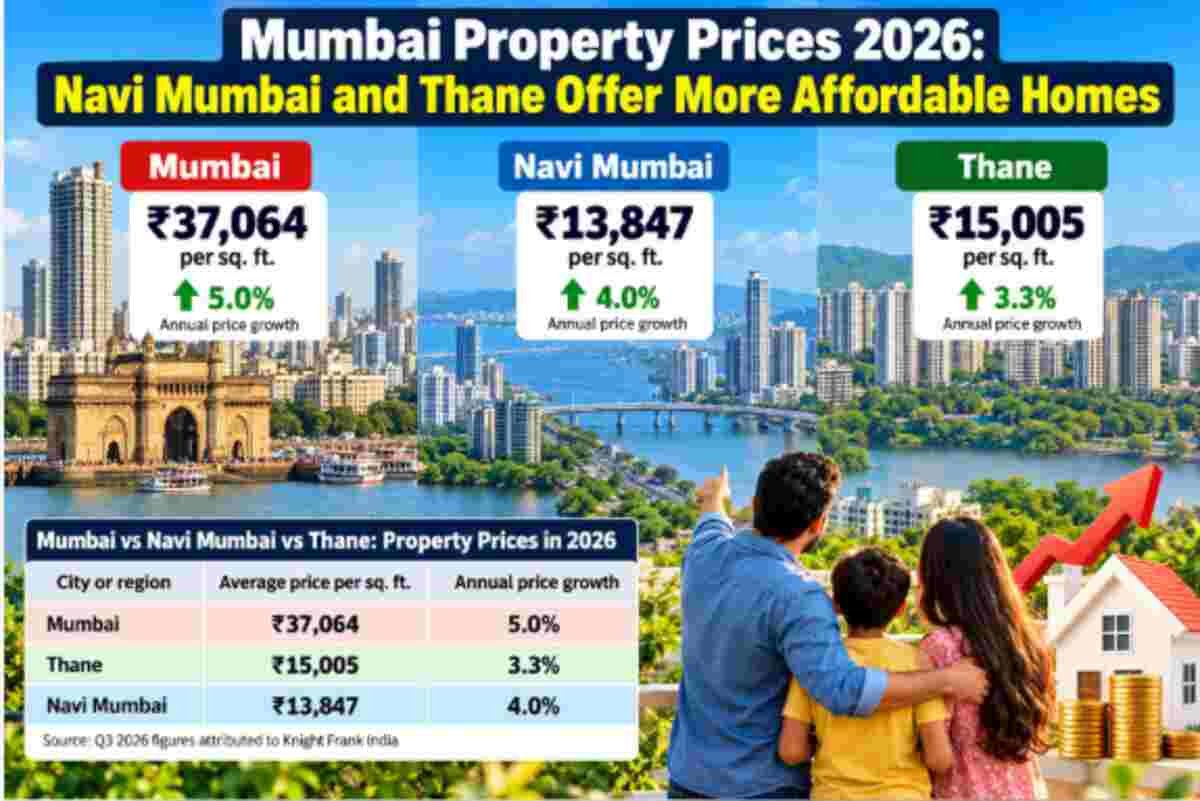
Mumbai: Buying a home in Mumbai remains a major financial challenge for middle-class families as residential property prices continue to remain high. However, homebuyers looking for more affordable options in the Mumbai Metropolitan Region (MMR) may find comparatively lower prices in Navi Mumbai and Thane.
According to the Q3 2026 figures attributed to property consultancy Knight Frank India, the average residential property price in Mumbai city reached ₹37,064 per square foot. In comparison, the average rate stood at ₹13,847 per square foot in Navi Mumbai and ₹15,005 per square foot in Thane.
The price difference makes these two locations attractive alternatives for buyers who want to own a home near Mumbai without paying the premium associated with the city itself.
Mumbai vs Navi Mumbai vs Thane: Property Prices in 2026
The reported third-quarter figures show a substantial difference in average residential property prices across the three locations.
| City or region | Average price per sq. ft. | Annual price growth |
|---|---|---|
| Mumbai | ₹37,064 | 5.0% |
| Thane | ₹15,005 | 3.3% |
| Navi Mumbai | ₹13,847 | 4.0% |
Source: Q3 2026 figures attributed to Knight Frank India in the supplied report.
Navi Mumbai recorded the lowest average residential property price among the three locations, followed by Thane. Mumbai city remained significantly more expensive.
These figures represent average prices across the respective markets. Actual property costs can vary depending on the neighbourhood, project, construction quality, amenities, connectivity and property configuration.
1. Navi Mumbai Property Prices: Average Rate at ₹13,847 per Sq. Ft.
Navi Mumbai has emerged as a comparatively affordable option for homebuyers considering properties in the Mumbai Metropolitan Region.
The reported average residential price in Navi Mumbai stood at ₹13,847 per square foot in Q3 2026. This is approximately 62.6% lower than Mumbai’s average price of ₹37,064 per square foot.
On an annual basis, property prices in Navi Mumbai increased by 4%, according to the supplied figures.
The lower average price may appeal to first-time homebuyers, salaried professionals and families looking for more space within a limited budget. However, affordability depends on the specific locality, transport access, maintenance costs and other ownership expenses.
Buyers should also compare commuting times, local infrastructure, schools, healthcare facilities and everyday amenities before choosing a property.
2. Thane Property Prices: Average Rate at ₹15,005 per Sq. Ft.
Thane is another option for buyers who want to live within the wider Mumbai region while exploring alternatives to Mumbai city’s comparatively high property prices.
According to the reported Q3 2026 data, the average residential property price in Thane stood at ₹15,005 per square foot. Prices increased by 3.3% year-on-year, the lowest annual growth rate among the three markets compared.
This slower increase may interest buyers looking for a market where reported price growth has remained relatively moderate. However, lower appreciation does not automatically guarantee better investment returns or future affordability.
Thane offers a range of residential locations, and prices differ depending on connectivity, neighbourhood infrastructure, project facilities and proximity to employment centres.
For families planning a home purchase, comparing the total cost of ownership and daily travel requirements is just as important as comparing the average price per square foot.
3. Mumbai Property Prices Cross ₹37,000 per Sq. Ft.
Mumbai continues to command a substantial premium in the residential property market.
The average residential property price in the city reached ₹37,064 per square foot in Q3 2026, representing annual growth of 5%, according to the supplied report.
For middle-income households, these prices can make purchasing a home difficult, particularly when buyers also need to account for registration charges, stamp duty, maintenance, parking and other expenses.
The supplied figures also suggest that Mumbai’s annual property price growth of 5% was broadly comparable to the cited retail inflation rate of 4.8%.
Nevertheless, the comparison should be interpreted carefully. Consumer inflation and residential property price growth measure different things, and a similar percentage change does not establish that housing has become more affordable.
For buyers unable to meet Mumbai’s price levels, Navi Mumbai and Thane provide alternative markets worth exploring.
4. Mumbai Home Sales in 2026: Which Budget Segment Leads?
The supplied data for the first nine months of calendar year 2026 shows home sales across several price categories in Mumbai.
| Property budget | Homes sold | Share of reported sales |
|---|---|---|
| Below ₹50 lakh | 26,136 | 36% |
| ₹50 lakh–₹1 crore | 17,601 | 24% |
| ₹1 crore–₹2 crore | 16,296 | 22% |
| ₹2 crore–₹5 crore | 9,861 | 14% |
| Above ₹5 crore | 2,910 | 4% |
Source: Home-sales figures supplied for the first nine months of calendar year 2026.
Homes priced below ₹50 lakh accounted for the largest reported segment, representing 36% of sales. Properties priced between ₹50 lakh and ₹1 crore contributed another 24%.
Together, the two categories accounted for 60% of the reported sales, indicating the importance of lower-budget housing in the figures provided.
However, the data should not be interpreted as proof that homes below ₹50 lakh are readily available across Mumbai city. The figures may cover a defined market area or property category, so buyers should verify the report’s geographical coverage and methodology before drawing broader conclusions.
5. Is Navi Mumbai Cheaper Than Mumbai?
Yes. Based on the reported average prices, Navi Mumbai is substantially cheaper than Mumbai city.
At ₹13,847 per square foot, Navi Mumbai’s average residential rate was approximately 62.6% lower than Mumbai’s ₹37,064 per square foot in Q3 2026.
Thane, at ₹15,005 per square foot, was approximately 59.5% cheaper than Mumbai city on the same comparison.
To illustrate the difference, consider a hypothetical 500-square-foot property priced at the reported market averages:
| Location | Illustrative property cost |
|---|---|
| Mumbai | ₹1.85 crore |
| Thane | ₹75.03 lakh |
| Navi Mumbai | ₹69.24 lakh |
These are mathematical illustrations based on average price per square foot, not actual property quotations. They exclude taxes, registration, stamp duty, parking, maintenance and other charges. Actual transaction prices may differ considerably.
6. What Should Homebuyers Check Before Purchasing?
Although Navi Mumbai and Thane offer lower reported average prices, buyers should assess more than the headline rate before making a decision.
- Total budget: Include the down payment, home loan EMI, stamp duty, registration and maintenance expenses.
- Connectivity: Compare travel times to workplaces, railway stations, metro connections and major roads.
- Project approvals: Verify the relevant regulatory registration, building approvals and property documentation.
- Developer track record: Review the developer’s completed projects, construction quality and delivery history.
- Neighbourhood infrastructure: Check access to schools, hospitals, shops and other essential services.
- Long-term affordability: Ensure that the EMI remains manageable after accounting for household expenses and emergency savings.
Buyers should also compare prices between individual neighbourhoods rather than relying solely on city-wide averages.
Conclusion: Affordable Housing Options Beyond Mumbai City
The reported Q3 2026 property figures highlight the price gap between Mumbai city and two major residential markets in the Mumbai Metropolitan Region.
Navi Mumbai recorded an average residential price of ₹13,847 per square foot, while Thane stood at ₹15,005 per square foot. Mumbai city was considerably more expensive at ₹37,064 per square foot.
For middle-class families and first-time homebuyers, these differences make Navi Mumbai and Thane important locations to consider when comparing housing options.
However, the right choice depends on the buyer’s budget, workplace, preferred neighbourhood, commuting needs and long-term financial plans. Comparing individual projects and the complete cost of ownership can help homebuyers make a more informed decision.

