

Written by – Kushagra Saxena & Astitwa Mishra
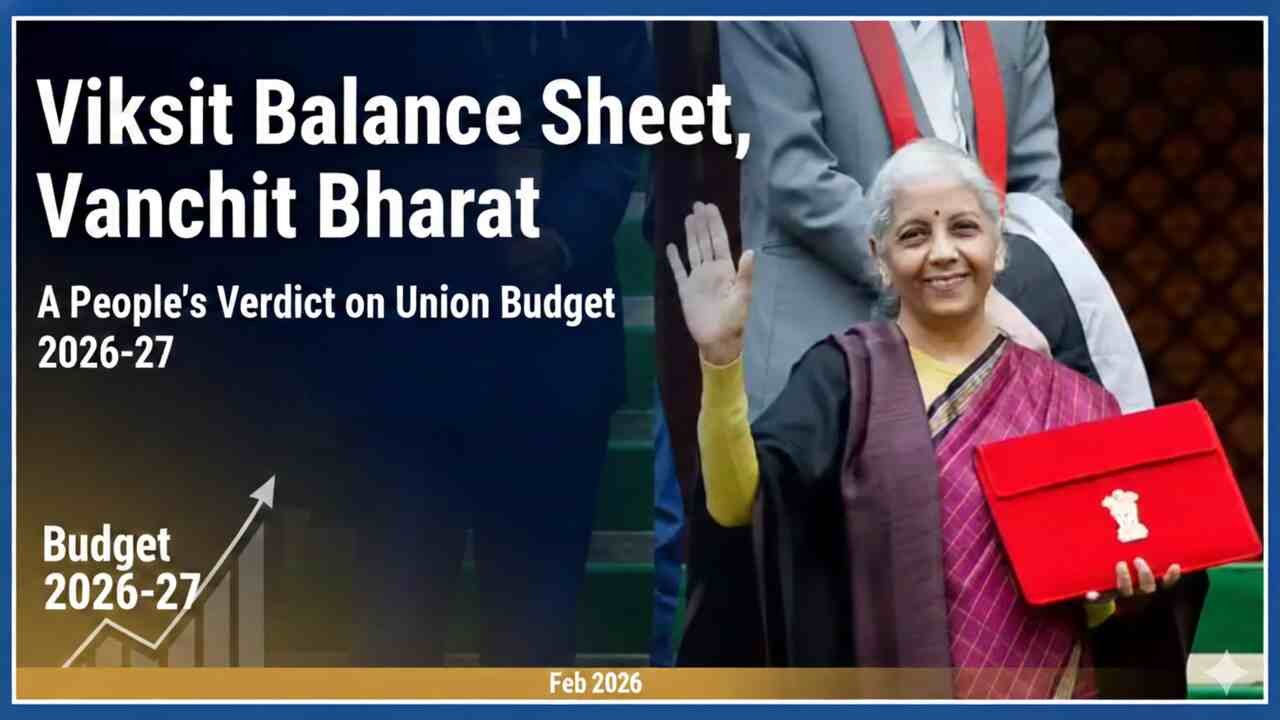
India’s latest Union Budget lands with a paradox: the government talks of “Viksit Bharat” while millions of unemployed graduates and underpaid workers and starving children and exhausted farmers experience a reality that better matches “Viksit Balance Sheet Vanchit Bharat”, which shows developed balance sheets but leaves people deprived. The numbers are grand, the rhetoric is soaring, yet the lived reality of inequality, unemployment and fraying public services tells a much larger story.
“4.3% Deficit”: Fiscal Magic or Fiscal Mirage?
India’s Budget demonstrates financial responsibility through its planned 2025-26 fiscal deficit and 2026-27 fiscal deficit which both meet the sub-4.5% target. Yet this masks steady high borrowing levels, with GDP growth assumptions shrinking the ratio relative to output.
The central government maintains its fiscal metrics under control while state governments face excessive debt-to-GSDP ratios that restrict their social expenditure capabilities.
High-Profit India vs Hungry India
On one side of today’s India stand record-breaking corporate profits, fat EBITDA margins and booming stock indices; on the other side stand undernourished children, anaemic women and informal workers surviving without income security. The Budget displays its preference through its decision to support anganwadis and ration shops and construction workers.
The earnings of companies have increased at a greater speed than both employment numbers and wage increases, while their profits and margins have reached new heights during a period of sluggish job development.
The Great Capex Mirage: Highways to Nowhere for the Jobless?
The Budget’s primary hero becomes capital expenditure when this situation resembles a movie. Public capital expenditure started at ₹2 lakh crore during 2014-15 and increased to more than five times that amount because the government planned to spend approximately ₹12.2 lakh crore during 2026-27.
The youth unemployment rate remains high at 10.2% (PLFS 2023-24) which exceeds the overall rate of 3.2% and includes urban young women who reach age 20. The latest quarterly data indicates that youth labor participation and employment will decrease throughout 2025.
Health and Mental Health: Shiny Institutes, Shaky Foundations
The Budget presents health announcements through delivery which creates a positive impression by displaying five years of work to train 100,000 Allied Health Professionals and ten key disciplines institutional upgrades and the establishment of a second national mental health institute in the northern region and the development of mental health centres which serve as main treatment facilities. The presentation shows his progress through technological advancement.
The health crisis in India requires a solution that exceeds existing methods because the country’s health system operates at its current capacity. The government spends less money on health care than the National Health Policy requires while mental health receives less than 1% of the health budget in most years.
MSMEs and Textiles: Champions on Paper, Choked on Credit
The Budget repeats a familiar promise: MSMEs are the backbone and the government will help them become “global champions.” The plan shows its dedication through a ₹10,000 crore SME Growth Fund and additional funding for preexisting fund-of-funds programs. Official and industry data demonstrate that MSMEs experience a credit shortage which ranges between ₹25 lakh crore and ₹30 lakh crore while large companies and government agencies create cash flow problems through their late payments.
According to recent research, the system contains over ₹7 lakh crore of outstanding debts which primarily affect micro businesses and constitute a significant portion of their gross value added.
TReDS platforms provide assistance to some businesses in India yet they reach only 1% of the country’s 60 million MSMEs who require complete funding support
CCUS and the Coal Lock-In: Green Talk, Grey Reality
The Budget 2026-27 document dedicates a budget of ₹20,000 crore for Carbon Capture Utilisation and Storage (CCUS) projects in power generation and heavy industry operations which will run for a period of five years. This technology provides three benefits because it enables cleaner coal production and low-carbon steel and cement manufacturing while supporting net-zero emissions goals without hindering economic expansion.
The experts show to people the need to proceed with caution because Coal power generation supplies approximately 70% of India’s electricity needs and this situation will continue into the future. The global market for CCUS technologies faces difficulties because of its expensive operations and complex systems which rely on fossil fuels for extended periods before switching to renewable energy sources.
A Budget with a Soul—or Just a Story?
The 2026-27 budget presents an impressive numerical display which includes substantial capital expenditures, a gradually decreasing budget deficit, prominent climate initiatives, and extensive funding programs that support multiple sectors. The moral character of budgets extends beyond their numerical content because they function as ethical documents. The documents demonstrate which individuals possess value as human beings since they define the limits of acceptable suffering and determine which dreams require market solutions and which aspects of safety remain untouchable.
The writers are Kushagra Saxena[1], a Data Science Professional., Media Coordinator and Spokesperson, All India Congress Committee (AICC).
Astitwa Mishra[2], a Law Student at Chandigarh University.
[1] https://x.com/kushagrasaxena_?s=11
[2] www.linkedin.com/in/astitwa-mishra-43921a236

