

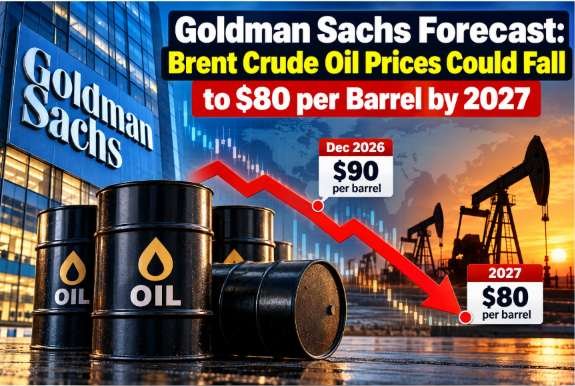
New Delhi: Global crude oil prices could decline in 2027 as oil supplies recover and the market moves towards a potential surplus. According to the forecast outlined in the report provided, Goldman Sachs expects the average price of Brent crude oil to reach around $80 per barrel in 2027, provided that supply conditions improve and geopolitical tensions ease.
The investment bank has raised its near-term price outlook amid continued uncertainty surrounding the Middle East. Its projections indicate that Brent crude could average $90 per barrel by December 2026, compared with its earlier estimate of $85 per barrel.
The outlook reflects two competing forces in the global oil market: the risk of supply disruptions linked to geopolitical tensions and the possibility of increased production exceeding demand. The future direction of prices will depend on how these factors evolve.
Note: The figures below reflect the forecasts described in the supplied material and should be verified against the original Goldman Sachs report before publication.
Goldman Sachs Expects Brent Crude to Average $90 in December 2026
Goldman Sachs has reportedly revised its near-term outlook for Brent crude oil, projecting an average price of $90 per barrel by December 2026. The estimate is higher than its previous forecast of $85 per barrel.
For 2027, the bank expects Brent crude to average $80 per barrel. This projection suggests that oil prices could moderate as supply disruptions ease, exports recover and the global market becomes better supplied.
However, the forecast does not guarantee that prices will fall to a particular level. Crude oil prices can change rapidly in response to geopolitical developments, production decisions by major oil-producing countries, changes in consumption and disruptions to transportation routes.
Global Oil Supply Shows Signs of Recovery
One of the key factors influencing the oil price outlook is the reported improvement in global supply.
According to the supplied report, oil exports from the Persian Gulf recovered towards levels seen in 2025 by the end of September. Exporting countries and energy companies reportedly adjusted transportation arrangements and made greater use of available export capacity during the period of disruption.
At the same time, production from regions outside the Persian Gulf helped support global availability.
These developments could reduce pressure on the oil market if they continue. Higher supplies would make it easier for refiners and importing countries to meet their requirements without relying as heavily on existing inventories.
Nevertheless, the recovery remains vulnerable to renewed conflict or restrictions affecting major oil-producing regions and shipping routes.
Oil Supply-Demand Gap Narrows From 7.2 Million to 0.3 Million Barrels Per Day
The report estimates that the gap between global oil supply and demand reached approximately 7.2 million barrels per day in March. By September, the gap had narrowed to around 0.3 million barrels per day.
This reported change points to a significant improvement in the market’s supply position.
As oil production and exports recover, the market may become less dependent on inventories to meet demand. If supply continues to strengthen while consumption remains subdued, prices could come under downward pressure.
However, the distinction between a supply-demand gap and a market surplus is important. The figures alone do not establish whether the market was in deficit or surplus at each point; that depends on how the original report defines and calculates the gap.
Why Crude Oil Prices May Include a $25 Risk Premium
Geopolitical uncertainty remains another major factor in the crude oil market.
According to the supplied report, current prices may include a risk premium of approximately $25 per barrel, reflecting concerns about a possible escalation involving the United States, Israel and Iran and the resulting threat to oil supplies.
A risk premium is the additional amount investors and market participants may factor into prices because of uncertainty about future supply.
If regional tensions disrupt oil production, exports or shipping, buyers may compete for limited available supplies. This could push crude oil prices higher, particularly if inventories decline.
On the other hand, a reduction in geopolitical tensions and a sustained recovery in exports could reduce the premium. If this happens alongside stronger production and weaker demand, crude oil prices could move lower.
The reported $25 premium should be treated as an estimate rather than a guaranteed amount that will disappear from prices.
Oil Market Could Move Towards a Surplus in Late 2026
Another important factor in Goldman Sachs’ reported outlook is the possibility that the global oil market could move towards a surplus from the fourth quarter of 2026.
A surplus occurs when the quantity of oil available exceeds the amount consumed over a given period. If this imbalance persists, inventories may rise and put downward pressure on crude oil prices.
Several factors could contribute to this scenario:
-
Recovering production: Higher output from oil-producing countries could increase global availability.
-
Improved Middle East exports: A return to more normal export flows could reduce supply constraints.
-
Moderating demand: Slower growth in consumption could limit the market’s ability to absorb additional production.
-
Reduced geopolitical risk: Lower concerns about supply disruptions could ease the premium embedded in oil prices.
However, the timing and scale of any surplus will depend on actual production, demand and inventory trends. A renewed disruption could quickly change the outlook.
What Could Push Crude Oil Prices Higher Instead?
Despite the potential for lower prices in 2027, the risks remain tilted in both directions.
An escalation of conflict involving the United States, Israel and Iran could disrupt oil production or shipments from the Middle East. Restrictions on major shipping routes could also increase transportation costs and delay deliveries.
Production cuts by major oil exporters, stronger-than-expected demand or a faster-than-anticipated decline in inventories could provide additional support to prices.
In such circumstances, Brent crude could remain above the projected average for longer than expected.
Conversely, a sustained recovery in supply combined with weaker consumption could strengthen the case for lower prices.
What Lower Crude Oil Prices Could Mean for India
India imports a substantial share of its crude oil requirements, making international oil prices an important factor for the domestic economy.
If global crude prices decline and the reduction is sustained, India could benefit from a lower import bill and reduced pressure on its oil-related trade balance. Lower input costs could also help moderate inflationary pressures across parts of the economy.
However, a fall in international crude oil prices does not automatically translate into an equivalent reduction in petrol and diesel prices in India.
Domestic fuel prices also depend on currency movements, refining and transportation costs, taxes, marketing decisions and other factors. A weaker rupee against the US dollar, for example, could offset part of the benefit from cheaper crude.
Consumers and businesses should therefore distinguish between a global oil price forecast and the actual prices they pay in India.
Outlook: Oil Prices Will Depend on Supply Recovery and Geopolitical Risks
Goldman Sachs’ reported forecast points to a potential easing in crude oil prices by 2027, with Brent crude expected to average $80 per barrel. The projection is based on an improvement in supply conditions, recovering exports and the possibility that production will outpace global demand.
For the remainder of 2026, however, geopolitical uncertainty could keep prices elevated. The reported December forecast of $90 per barrel reflects the possibility that supply risks will continue to influence the market in the near term.
Ultimately, the direction of crude oil prices will depend on whether global supply normalizes, demand remains moderate and tensions in the Middle East ease. The $80-per-barrel forecast is a scenario to watch, not a guaranteed outcome.
Frequently Asked Questions (FAQs)
1. What is Goldman Sachs’ crude oil price forecast for 2027?
According to the supplied report, Goldman Sachs expects Brent crude oil to average $80 per barrel in 2027.
2. What is the Brent crude forecast for December 2026?
The supplied material puts the projected average price at $90 per barrel by December 2026, up from the earlier estimate of $85.
3. Why could crude oil prices fall in 2027?
Prices could decline if global production and Middle East exports recover, demand growth moderates and the market moves into a surplus.
4. Could Middle East tensions push oil prices higher?
Yes. Disruptions to production, exports or shipping routes could restrict supply and push crude oil prices higher.
5. Will lower crude oil prices reduce petrol and diesel prices in India?
Not necessarily. Domestic fuel prices also depend on the rupee-dollar exchange rate, taxes, refining costs and fuel-pricing decisions.

