

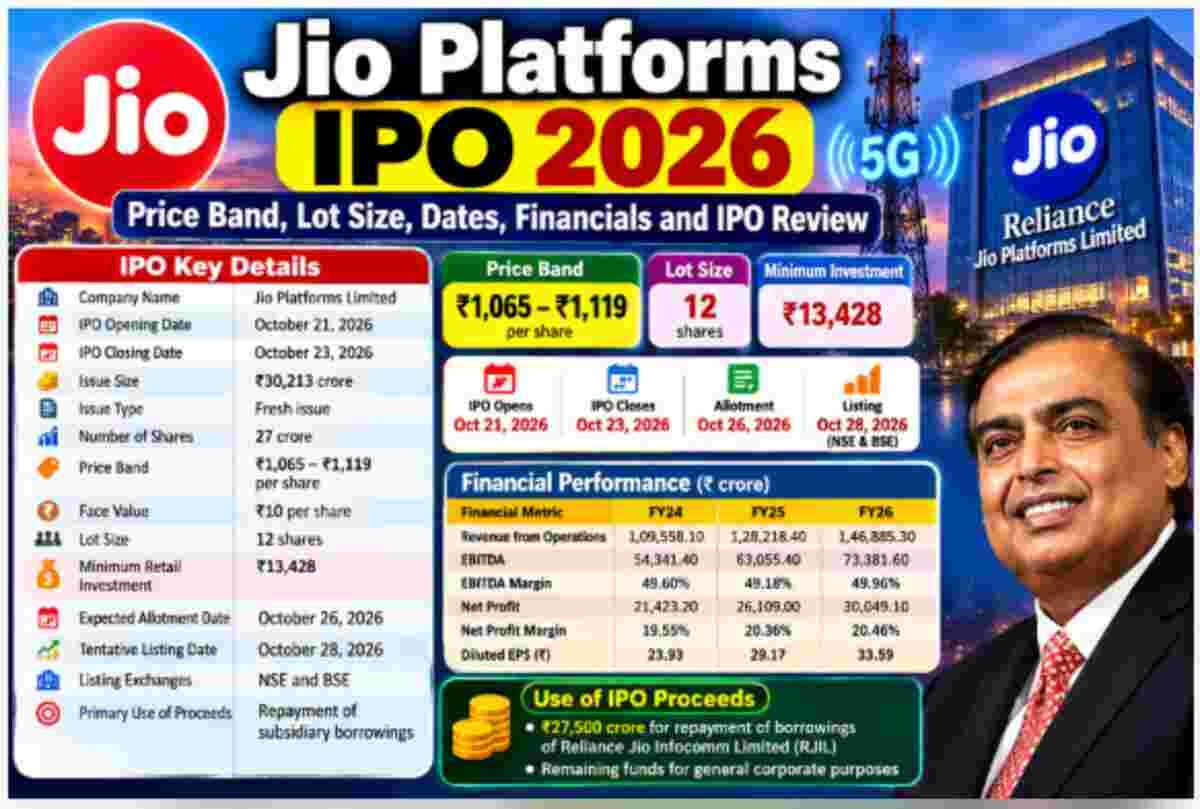
Jio Platforms IPO 2026: Jio Platforms Limited is set to launch its initial public offering (IPO) on October 21, 2026, with plans to raise ₹30,213 crore through a fresh issue of 27 crore equity shares. The price band has been fixed at ₹1,065 to ₹1,119 per share, while retail investors will need a minimum investment of ₹13,428 for one lot of 12 shares at the upper price band.
The issue will remain open until October 23, 2026, with listing tentatively scheduled for October 28 on the National Stock Exchange (NSE) and BSE. Investors evaluating the Jio Platforms IPO should examine the company’s financial growth, valuation, debt position, competitive advantages and potential risks before making an investment decision.
According to the company’s public offering documents, the proceeds will primarily be used to repay borrowings of its material subsidiary, Reliance Jio Infocomm Limited (RJIL). The IPO has also attracted considerable institutional interest ahead of its opening. However, strong demand does not guarantee listing gains or long-term investment returns.
Jio Platforms IPO 2026: Key Details
| Particulars | Details |
|---|---|
| Company name | Jio Platforms Limited |
| IPO opening date | October 21, 2026 |
| IPO closing date | October 23, 2026 |
| Issue size | ₹30,213 crore |
| Issue type | Fresh issue |
| Number of shares | 27 crore |
| Price band | ₹1,065–₹1,119 per share |
| Face value | ₹10 per share |
| Lot size | 12 shares |
| Minimum retail investment | ₹13,428 |
| Expected allotment date | October 26, 2026 |
| Tentative listing date | October 28, 2026 |
| Listing exchanges | NSE and BSE |
| Primary use of proceeds | Repayment of subsidiary borrowings |
Source: Company offering documents and IPO disclosures. Dates and other issue details should be reconfirmed from the final exchange announcements.
What Is Jio Platforms Limited?
Jio Platforms Limited is the digital connectivity and technology business promoted by Reliance Industries Limited. Incorporated in November 2019, the company operates through its material subsidiary, Reliance Jio Infocomm Limited, which provides mobile and broadband connectivity services.
Its business portfolio includes 4G and 5G mobile services, JioFiber, JioAirFiber, enterprise connectivity, cloud solutions, Internet of Things (IoT) services and artificial intelligence-related technology.
Jio has established a large telecommunications network across India. The figures provided in the company’s offering-related information indicate a customer base of approximately 533.3 million, including around 284.9 million 5G customers. Its network infrastructure comprises hundreds of thousands of towers and more than one million route kilometres of fibre.
The company also has strategic relationships with global technology companies, including Meta and Google, which have invested in Jio Platforms.
Jio’s scale, technology infrastructure and broad digital services portfolio are central to its growth strategy. Nevertheless, investors should distinguish the company’s market leadership from the returns they may earn by purchasing shares at the IPO price.
Jio Platforms IPO: Why Is the Company Going Public?
The ₹30,213 crore offering is structured entirely as a fresh issue, rather than an offer for sale by existing shareholders.
The principal objective is to reduce the borrowing burden of Reliance Jio Infocomm Limited.
How will the IPO proceeds be used?
- Debt repayment: Approximately ₹27,500 crore is earmarked for full or partial prepayment of borrowings, primarily external commercial borrowings, taken by RJIL.
- General corporate purposes: The remaining eligible net proceeds, after issue expenses, will be used for general corporate purposes, subject to the limits specified in the offering documents.
- Balance-sheet improvement: Repaying debt could reduce interest expenses and improve financial flexibility, depending on the company’s subsequent borrowing and cash-flow requirements.
A fresh issue brings new capital into the company. However, investors should remember that repayment of subsidiary debt does not automatically translate into higher earnings per share or an increase in the market price after listing.
Jio Platforms Financial Performance: Revenue and Profit Growth
Jio Platforms has reported consistent growth in revenue, operating earnings and net profit over the three financial years presented in its restated consolidated financial statements.
Revenue and profitability
| Financial metric | FY24 | FY25 | FY26 |
|---|---|---|---|
| Revenue from operations | ₹1,09,558.10 crore | ₹1,28,218.40 crore | ₹1,46,885.30 crore |
| EBITDA | ₹54,341.40 crore | ₹63,055.40 crore | ₹73,381.60 crore |
| EBITDA margin | 49.60% | 49.18% | 49.96% |
| Net profit | ₹21,423.20 crore | ₹26,109.00 crore | ₹30,049.10 crore |
| Net profit margin | 19.55% | 20.36% | 20.46% |
| Diluted EPS | ₹23.93 | ₹29.17 | ₹33.59 |
Figures are based on the financial information supplied from the company’s restated consolidated financial statements.
Revenue increased from approximately ₹1.10 lakh crore in FY24 to ₹1.47 lakh crore in FY26. Net profit also rose from ₹21,423.20 crore to ₹30,049.10 crore during the same period.
The company’s EBITDA margin remained close to 50%, indicating strong operating profitability in its core business. Its net profit margin improved to 20.46% in FY26.
These results provide evidence of growing scale and profitability. However, future performance will depend on subscriber growth, pricing, customer retention, network investment, operating expenses and competition.
Balance sheet and cash flow
| Financial metric | FY24 | FY25 | FY26 |
|---|---|---|---|
| Total assets | ₹5,39,580.40 crore | ₹5,81,233.80 crore | ₹6,15,594.00 crore |
| Net worth | ₹2,77,866.10 crore | ₹3,04,022.40 crore | ₹3,34,013.40 crore |
| Total borrowings | ₹54,348.90 crore | ₹73,060.30 crore | ₹70,781.00 crore |
| Cash flow from operations | ₹57,661.60 crore | ₹68,155.70 crore | ₹77,556.30 crore |
Operating cash flow increased to ₹77,556.30 crore in FY26, supporting the company’s ability to generate cash from its business operations.
Reported borrowings declined from ₹73,060.30 crore in FY25 to ₹70,781 crore in FY26. The proposed repayment of ₹27,500 crore could further reduce debt, subject to the actual use of proceeds and subsequent financing requirements.
Investors should also consider deferred spectrum payment obligations, which are separate from reported borrowings and may represent a significant future cash commitment.
Jio Platforms IPO Valuation: Is the Price Attractive?
At the upper price band of ₹1,119 per share, Jio Platforms is valued at approximately 33.31 times its FY26 diluted earnings per share, based on the supplied financial figures.
The valuation needs to be considered alongside the company’s growth, profitability, capital structure and competitive position.
Jio Platforms vs Bharti Airtel and Vodafone Idea
| Metric | Jio Platforms | Bharti Airtel | Vodafone Idea |
|---|---|---|---|
| FY26 revenue from operations | ₹1,46,885.30 crore | ₹2,10,972.80 crore | ₹44,873 crore |
| Diluted EPS | ₹33.59 | ₹44.37 | ₹3.21 |
| NAV per share | ₹373.66 | ₹244.60 | -₹3.30 |
| P/E ratio | 33.31x | 40.71x | 3.99x |
| Return on net worth | 9.42% | 20.32% | Not meaningful |
Source: Figures supplied from the article’s peer-comparison data. The Vodafone Idea P/E ratio requires caution because exceptional gains and negative net worth can distort comparisons.
At the stated valuation, Jio Platforms trades at a lower P/E multiple than Bharti Airtel. This may appear attractive when considered alongside Jio’s revenue growth and operating margins.
However, the difference in return on net worth is important. Jio’s FY26 RoNW of 9.42% is below Bharti Airtel’s 20.32%. A lower P/E ratio alone is not sufficient evidence that a stock is undervalued.
Vodafone Idea’s low reported P/E ratio is also not directly comparable because exceptional gains can distort earnings-based valuation measures.
Investors should compare businesses using normalised earnings, cash flow, debt obligations, capital expenditure and future growth assumptions rather than relying on one valuation metric.
Jio Platforms IPO Growth Prospects
1. Expansion of 5G services
Jio’s large customer base and established network infrastructure position it to benefit from increasing 5G adoption. Higher usage of data-intensive applications could support revenue growth and encourage customers to adopt higher-value plans.
However, continued network investment and competitive pricing could affect the profitability of this expansion.
2. Rising average revenue per user
Average revenue per user (ARPU) is an important indicator of telecommunications profitability. Industry ARPU is projected in the supplied industry analysis to rise from ₹199.50 per month to ₹326.40 by FY31.
Higher tariffs, improved customer mix and greater consumption of digital services could increase revenue per subscriber. The outcome will depend on customer affordability, competitive responses and churn.
3. Fixed broadband and JioAirFiber
India’s fixed broadband market offers another potential growth opportunity. Fibre and fixed wireless access services could expand connectivity in areas where traditional broadband infrastructure is limited.
The industry projections cited in the company’s offering-related material estimate that the fixed broadband market could grow substantially by FY31.
Jio’s existing infrastructure and distribution network could help it participate in this expansion, although rollout costs and competition remain important considerations.
4. Enterprise services, cloud and artificial intelligence
Jio Platforms is expanding beyond consumer telecommunications into enterprise connectivity, cloud computing, IoT and AI-related services.
These offerings could diversify revenue sources and create opportunities to serve businesses seeking digital infrastructure and technology solutions.
The commercial success of these initiatives will depend on customer adoption, product differentiation, execution and the company’s ability to generate returns on additional investment.
Jio Platforms IPO SWOT Analysis
Strengths
- Large subscriber base and substantial market presence in Indian telecommunications.
- Established 4G and 5G infrastructure.
- Revenue and net profit growth over FY24–FY26.
- EBITDA margins close to 50%.
- Strong operating cash flow.
- Expansion opportunities across broadband, enterprise connectivity and digital services.
Weaknesses
- FY26 return on net worth is below that of Bharti Airtel.
- Significant spectrum-related payment obligations remain relevant to the balance sheet.
- Finance costs increased from ₹4,047.60 crore in FY24 to ₹8,653.40 crore in FY26.
- Dependence on the wider Reliance group distribution ecosystem should be evaluated.
- A large capital base can affect return-based financial ratios.
Opportunities
- Growing demand for 5G connectivity.
- Higher industry ARPU.
- Expansion of fibre broadband and fixed wireless access.
- Enterprise cloud, IoT and AI services.
- Potential monetisation of proprietary telecommunications technology and intellectual property.
Threats
- Intense competition from Bharti Airtel and Vodafone Idea.
- Customer churn following tariff increases.
- Regulatory changes involving telecom licences, spectrum and pricing.
- Large ongoing infrastructure and technology investment requirements.
- Execution risks in emerging digital services.
- Contingent liabilities and deferred spectrum obligations.
Jio IPO Grey Market Premium (GMP)
The grey market premium is an unofficial indicator of investor sentiment before a public listing. Reports published ahead of the IPO opening have cited premiums in the region of ₹200–₹250 per share, although the figure can change quickly.
GMP is not an exchange-traded price, an official company forecast or a guarantee of listing gains. It can differ significantly across informal market sources and may not translate into actual listing performance.
Investors should verify the latest reported figure and its timestamp before publication. They should also avoid estimating guaranteed returns by simply adding the GMP to the IPO price.
Jio Platforms IPO Review: Should Investors Apply?
Jio Platforms presents a combination of scale, revenue growth, strong operating margins and opportunities in 5G, fixed broadband and enterprise digital services. Its proposed debt repayment could also improve financial flexibility.
At the same time, the IPO valuation, lower return on net worth compared with Bharti Airtel, spectrum-related obligations and competitive pressures warrant careful consideration.
The company’s FY26 diluted earnings and the proposed upper price band imply a P/E ratio of approximately 33.31 times. Whether this valuation is justified will depend on future earnings growth, cash generation and the returns generated from its digital and telecommunications investments.
Investors primarily seeking listing gains should be particularly cautious about relying on grey market premiums or reports of heavy institutional demand. Long-term investors should focus on the company’s earnings outlook, valuation, capital requirements and ability to sustain profitability.
Overall assessment: Jio Platforms has a substantial operating footprint and several potential growth drivers, but the IPO should be evaluated on its financial fundamentals and valuation rather than market excitement alone. The decision to apply should reflect an investor’s risk tolerance, investment horizon and independent assessment of the offering documents.
Frequently Asked Questions (FAQs)
1. When will the Jio Platforms IPO open?
The IPO is scheduled to open on October 21, 2026, and close on October 23, 2026.
2. What is the Jio IPO price band?
The price band is ₹1,065 to ₹1,119 per equity share.
3. What is the minimum investment for the Jio IPO?
The lot size is 12 shares. At the upper price band of ₹1,119, the minimum investment is ₹13,428, excluding any applicable charges.
4. What is the total issue size?
Jio Platforms plans to raise ₹30,213 crore through a fresh issue of 27 crore equity shares.
5. What is the expected Jio IPO listing date?
The tentative listing date is October 28, 2026, on NSE and BSE, subject to the final issue schedule and exchange announcements.
6. How will Jio Platforms use the IPO proceeds?
The company plans to use approximately ₹27,500 crore to repay borrowings of Reliance Jio Infocomm Limited, with the remaining eligible proceeds allocated to general corporate purposes under the offering terms.
7. Is the Jio Platforms IPO a good investment?
The answer depends on the investor’s objectives, risk tolerance and assessment of the company’s valuation and future performance. Revenue growth and strong margins are positives, while valuation, competition and spectrum-related liabilities require consideration.
8. Does a high GMP guarantee listing gains?
No. GMP is an unofficial market indicator and does not guarantee the listing price or the return an investor may earn.
Disclaimer: This article is for general informational and educational purposes only and is not investment, financial, legal or tax advice. IPO details and financial figures should be verified against the latest official red herring prospectus and exchange disclosures. Investors should conduct independent research or consult a qualified financial adviser before making investment decisions.

