

Kishore Kumar was one of the most versatile and celebrated personalities in Indian cinema. Known for his extraordinary singing, memorable acting and distinctive sense of humour, he created a legacy that continues to inspire music lovers across generations.
However, Kishore Kumar was not known only for his artistic talent. Stories about his outspoken personality and unusual ways of handling situations have also become part of Bollywood folklore.
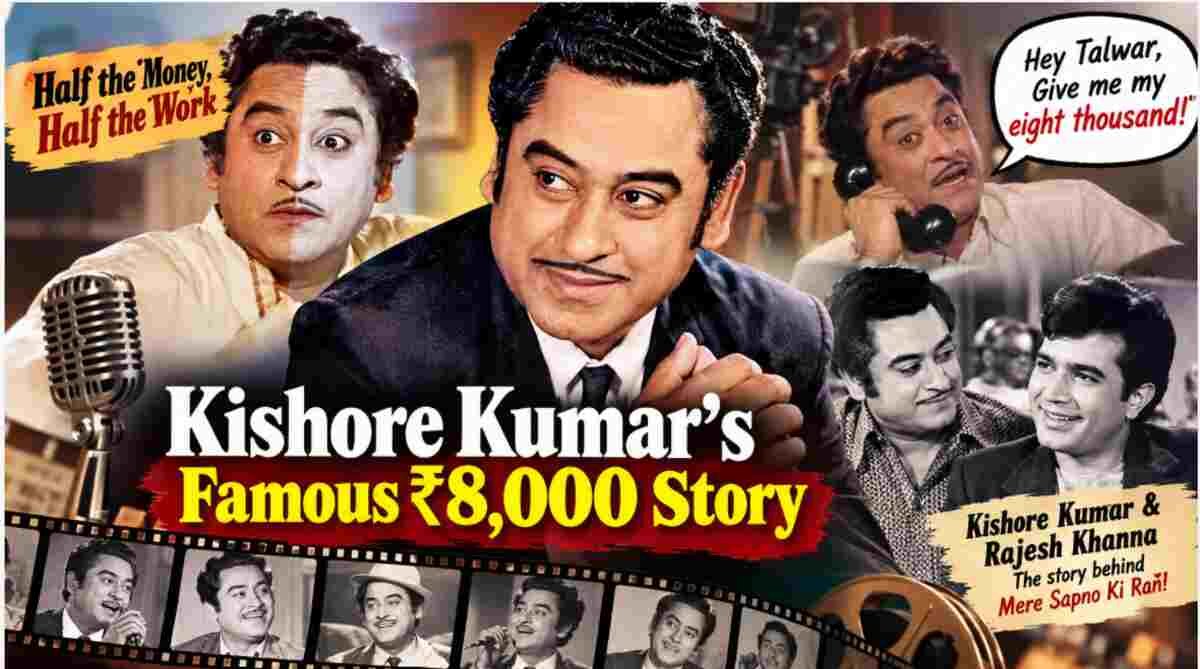
One such widely circulated anecdote concerns a reported payment dispute with a film producer. According to the story, Kishore Kumar once arrived on a film set with makeup applied to only half his face after allegedly receiving only half of his agreed fee. His explanation was as memorable as the incident itself: “Half the money, half the work.”
Another story involves his reported demand for ₹8,000 from producer R.C. Talwar. His interactions with Rajesh Khanna and the story behind the evergreen song “Mere Sapno Ki Rani” offer further glimpses into the world of this legendary entertainer.
Here are some of the most memorable stories associated with Kishore Kumar’s life and career.
1. Kishore Kumar’s Half-Makeup Protest: Half the Money, Half the Work
Kishore Kumar’s unconventional personality is reflected in a famous anecdote about a payment dispute on a film set.
According to the widely circulated story, the singer-actor arrived for a shoot with makeup applied to only one half of his face. The unusual appearance surprised the people present, who wanted to know why he had chosen to appear that way.
Kishore Kumar reportedly explained that the producer had paid him only half his agreed fee. His response was straightforward: if he received half the money, he would do only half the work. Full payment, according to the anecdote, meant completing the entire job.
The incident has become one of the best-known stories associated with his personality. It portrays a performer who was willing to make his point in a memorable and unconventional way.
Although the exact details of this anecdote should be verified through reliable historical sources, the story continues to circulate among fans of classic Hindi cinema.
2. The ₹8,000 Demand: Why Kishore Kumar Reportedly Visited a Producer’s House
Another popular story concerns film producer R.C. Talwar and an alleged outstanding payment of ₹8,000.
According to the anecdote, Kishore Kumar was working on a film associated with Talwar when a portion of his agreed fee reportedly remained unpaid. The amount in dispute was said to be ₹8,000.
Rather than quietly waiting for the money, Kishore Kumar allegedly visited the producer’s residence repeatedly and called out for his payment.
The memorable words attributed to him were: “Hey Talwar, give me my eight thousand!”
The story has remained popular because it captures the singer’s reportedly direct approach to money matters. It also reflects a broader issue in the film industry: artists and technicians depend on timely payments for their professional work.
However, the exact circumstances of the alleged dispute, including the amount and frequency of these visits, should be treated as an anecdote unless confirmed by dependable contemporary records or firsthand accounts.
3. Kishore Kumar and Rajesh Khanna: The Story Behind ‘Mere Sapno Ki Rani’
Kishore Kumar and Rajesh Khanna became one of the most memorable actor-singer combinations in Hindi cinema. Their musical association produced songs that remain popular decades after their release.
One of the most celebrated examples is “Mere Sapno Ki Rani,” from the 1969 film Aradhana. The song features Rajesh Khanna on screen, with Kishore Kumar providing the playback vocals.
A popular anecdote about their association suggests that Kishore Kumar wanted to meet Rajesh Khanna in person before agreeing to sing for the young actor. According to the story, Rajesh Khanna visited the singer’s home, where they spoke about his ambitions and reasons for entering the film industry.
The anecdote further claims that Kishore Kumar was impressed by Rajesh Khanna’s response about entertaining people through films.
Whatever the precise details of the conversation, their subsequent collaboration became an important part of Hindi film music history.
“Mere Sapno Ki Rani” helped establish the enduring appeal of their on-screen and musical partnership. The song remains associated with the romance and musical style of late-1960s Bollywood.
4. Kishore Kumar’s Death Anniversary: Remembering the Legendary Artist
Kishore Kumar died on October 13, 1987, at the age of 58. His death marked the loss of one of India’s most distinctive entertainers, whose contributions extended well beyond playback singing.
He was celebrated for his versatility, moving effortlessly between romantic songs, comic performances, emotional melodies and energetic musical numbers.
His singing career included memorable collaborations with leading composers and lyricists, while his acting career demonstrated his natural comic timing and distinctive screen presence.
Kishore Kumar’s work continues to reach new generations through radio, television, streaming services and digital music platforms. His songs remain an important part of India’s popular music heritage.
October 13 provides an opportunity for fans to revisit his remarkable body of work and remember the artist behind some of Hindi cinema’s most enduring melodies.
5. The Story About Kishore Kumar’s Final Day
An emotional anecdote associated with Kishore Kumar’s final day concerns his wife, Leena Chandavarkar.
According to a story circulated about his final hours, Kishore Kumar reportedly startled his wife earlier that day by pretending to be unresponsive before suddenly opening his eyes. The anecdote describes the moment as an example of his unusual sense of humour.
Later, after lunch, Leena Chandavarkar reportedly found him collapsed and sought help. Kishore Kumar died on October 13, 1987.
The story is often retold because of its emotional contrast: a moment of apparent mischief followed by the tragedy of his death.
However, details about his final hours and the precise sequence of events should be confirmed through reliable biographical accounts and firsthand statements. Anecdotes about a person’s death can become distorted over time, so it is important to distinguish documented facts from popular retellings.
6. Why Kishore Kumar Remains a Bollywood Legend
Kishore Kumar’s legacy rests on far more than colourful stories about his personality. His contribution to Indian music and cinema was extraordinary.
A versatile playback singer: He could deliver romantic melodies, playful songs, emotional performances and energetic numbers with remarkable ease.
A distinctive actor: His comic timing, expressions and unconventional performances made him a memorable screen presence.
An enduring musical legacy: His songs continue to attract listeners across generations, languages and age groups.
A unique personality: Stories about his humour, professional disagreements and unusual behaviour have contributed to the popular image of Kishore Kumar as an unpredictable and original artist.
His career demonstrated that artistic individuality could become a defining strength. Even decades after his death, his voice remains instantly recognisable to millions of music lovers.
Conclusion
Kishore Kumar’s life continues to fascinate audiences because of his remarkable talent, memorable songs and distinctive personality. Stories about his alleged ₹8,000 payment dispute, his reported half-makeup protest and his musical association with Rajesh Khanna remain part of the many anecdotes shared about classic Bollywood.
While some details of these stories require historical verification, his contribution to Indian entertainment is beyond question. His songs, performances and musical versatility continue to bring joy to listeners.
On his death anniversary, October 13, fans can remember Kishore Kumar not only for the stories surrounding his life but also for the timeless music and performances that secured his place among Hindi cinema’s most celebrated artists.

