

NEW DELHI:On high-speed national expressways and unlit rural corridors, night driving pushes human perception to its limits. At 90 km/h, a driver covers 25 meters every single second. In poor weather, fog, or blinding darkness, spotting a stalled tractor-trailer or an oversized container truck just two seconds too late turns into a catastrophic fatality.
Yet, long before a truck’s headlights cut through the gloom or its engine comes within earshot, a distinctive pattern of luminous tape outlines its massive chassis: clean white running across the cab front, bold amber-yellow outlining the trailer flanks, and bright crimson-red framing the tailgate.
This strict color assignment is neither decorative nor random branding. It represents an internationally standardized, legally binding visual protocol engineered around human optics, optical physics, and road safety psychology.
The Legal Framework: UN Standards and India’s CMVR Protocol
Commercial vehicle contour marking is governed by stringent global and domestic regulations. Internationally, the benchmark is set by the United Nations Economic Commission for Europe (UN ECE) Regulation 104, which dictates the color, photometric performance, and placement of retro-reflective contour markings on heavy-duty vehicles across Europe and
allied markets.
In India, the Ministry of Road Transport and Highways (MoRTH) implemented these provisions under Rule 104 of the Central Motor Vehicles Rules (CMVR), 1989, and aligned technical standards via the Automotive Industry Standards (specifically AIS-090).
The statutory mandate specifies:
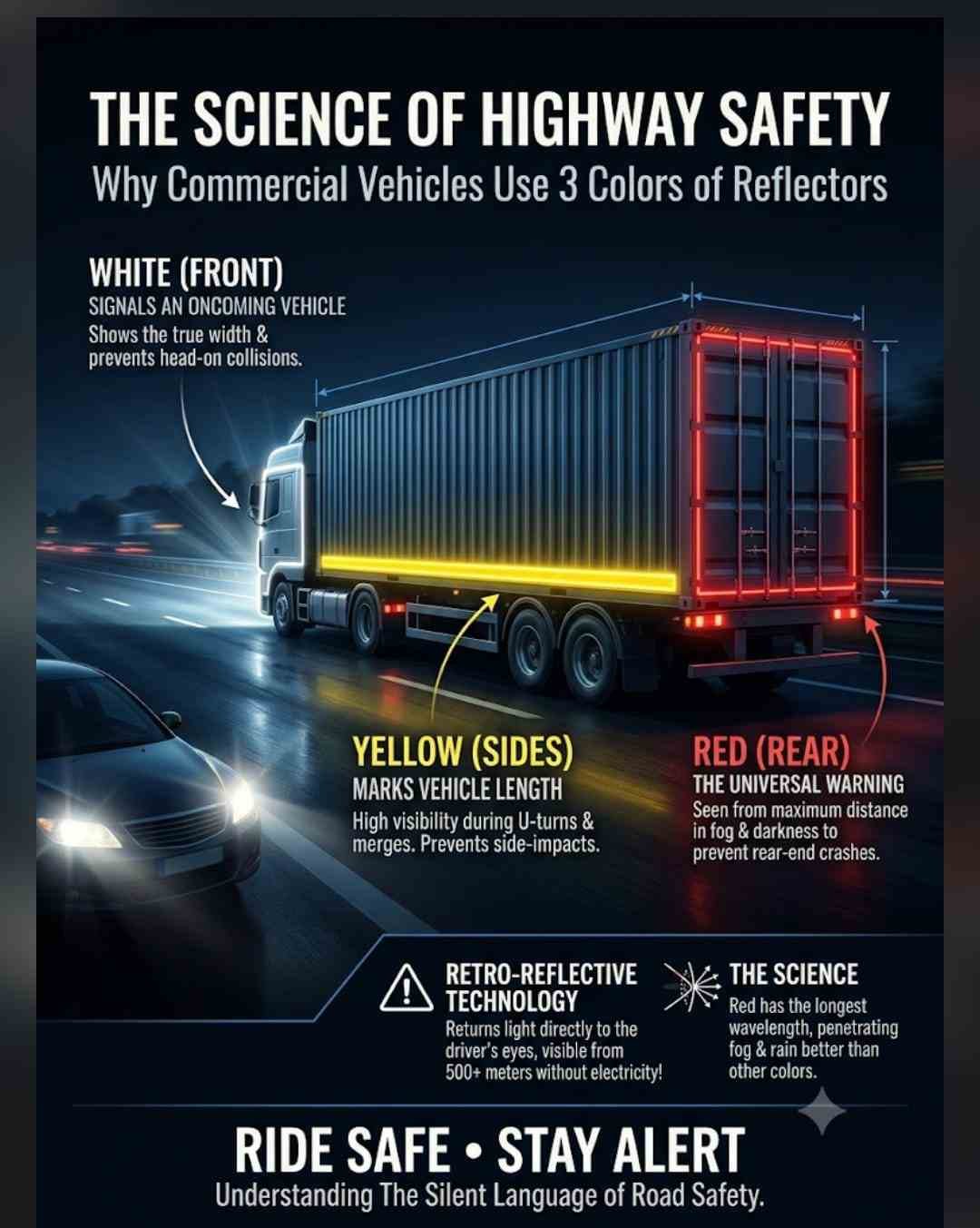
Front: High-intensity White retro-reflective markings to outline front horizontal width and vertical clearance.
Sides: High-intensity Yellow (Amber) striping outlining at least 80% of the vehicle’s profile length.
Rear: High-intensity Red markings framing the entire perimeter of the tailgate and chassis width.
Vehicles lacking these certified retro-reflective tapes fail mandatory annual fitness inspections, incur steep transport department fines, and face immediate impoundment during interstate safety checks.
1. Front Markings: White for Oncoming Presence and Dimension
In worldwide automotive nomenclature, white light has always been the exclusive signifier of an oncoming vehicle’s leading edge—most visibly mirrored in headlamps and front parking lights.
Directional Clarity:
When oncoming drivers see white reflection ahead, their cognitive processing triggers an immediate deduction: an object is heading toward me or facing directly down the lane. There is zero ambiguity regarding whether the vehicle is traveling away or crossing perpendicularly.
Preventing the “Single-Headlamp” Illusion:
A common hazard on Indian highways involves heavy commercial vehicles operating with one burned-out headlight. To a driver approaching from hundreds of meters away, a single beam often registers as a two-wheeler, tempting an ill-advised overtaking maneuver into the oncoming lane.
Contour-taped white reflections span the entire frontal perimeter—from the bumper edges up to the cabin roof corners. Even if all electrical circuits fail completely, the headlights of an oncoming car illuminate the true width and towering height of the approaching truck, preventing catastrophic head-on crashes.
2. Rear Markings: Red for Universal Caution and Optical Penetration
Rear-end collisions account for a disproportionate share of highway deaths, particularly when broken-down trucks park along shoulder lanes without deploying hazard triangles. Red is strictly designated for the rear, serving critical optical and psychological roles. The Physics of Wavelength and Fog Penetration:
Within the visible light spectrum, red light possesses the longest wavelength—measuring approximately 620 to 750 nanometers. According to Rayleigh’s scattering law, the scattering of light by microscopic atmospheric particles (such as water droplets, smog, and dust) is inversely proportional to the fourth power of
wavelength.
Because red light features the longest wavelength, it scatters the least. It punches through dense winter fog, heavy monsoon downpours, and swirling highway dust far more effectively than shorter wavelengths like blue, green, or violet.
Instinctive Brake Response:
Through decades of conditioned visual ergonomics, the human brain associates red with tail lamps, stop signs, and imminent danger. Spotting a vivid red frame on a dark carriageway triggers subconscious muscle memory: the driver lifts off the throttle and hovers over the brake pedal instantly, shaving critical milliseconds off braking reaction distance.
3. Lateral Markings: Yellow/Amber for Length and Flank Visibility Some of the deadliest highway collisions occur not from the front or rear, but as perpendicular T-bone crashes (underride accidents) during nighttime U-turns, intersection crossings, or merges from highway dhabas and toll plazas.
Consider a 50-foot multi-axle trailer executing a slow three-point turn across a four-lane divided highway at 2:00 AM. Its headlights face west; its taillights face east. The vast middle portion of the trailer—a dark, flatbed steel chassis—sits directly across the oncoming north-south lanes, invisible in unlit conditions. Motorists approaching at high speed see empty space below the horizon and can drive straight beneath the trailer bed before their
headlights illuminate the bare steel beams.
The Strategic Value of Amber-Yellow:
Defining True Length: Continuous yellow markings transform an invisible trailer into a bright, reflective perimeter line, signaling to lateral traffic that a wide obstacle blocks the right-of-way.
Eliminating Directional Confusion: If sides were taped white, approaching traffic from side lanes might assume a vehicle is approaching them frontally. If sides were taped red, drivers might misinterpret the barrier as a vehicle moving away. Yellow/Amber sits precisely in between, universally communicating a lateral profile or turning movement.
Contrast Against Asphalt: Yellow provides distinct contrast against asphalt pavement and dark roadside terrain, ensuring visibility under both direct headlights and ambient twilight.
Engineering the Glare: Retro-Reflection vs. Ordinary Tape
The materials used on heavy commercial carriers are not simple adhesive vinyl or radium strips. They are engineered micro-prismatic retro-reflective tapes (often meeting Class C photometric specifications under international codes).
Ordinary reflective materials or flat mirrors reflect light at an equal angle of bounce away from the source (specular reflection), scattering the beam into roadside ditches or the sky.
In contrast, retro-reflective tape contains millions of precision-engineered microscopic prisms (full-cube corner prisms) embedded beneath a resilient acrylic or polycarbonate top film. When a motor vehicle’s headlamp beam strikes these micro-prisms:
The light enters the prism face.
It undergoes internal reflection three times across perpendicular facets.
It is returned directly along its incident path—straight back into the eye-level cone of the originating vehicle’s driver.
This precision optics allows an unpowered piece of tape to reflect light up to 1,000 times brighter than white paint, generating visibility from distances exceeding 500 to 800 meters without drawing a single watt of battery power.
Measurable Reductions in Nighttime Collisions
Real-world deployment demonstrates the lifesaving efficacy of this three-color scheme. Extensive longitudinal studies conducted by the US National Highway Traffic Safety Administration (NHTSA) demonstrated that retro-reflective contour tape on commercial trailers reduced side and rear impacts by 29% to 41% in dark conditions. In foggy or inclement weather, the reduction reached 44%.
On high-density Indian freight corridors like the Golden Quadrilateral, where stationary vehicles parked on live carriage lanes represent an ever-present hazard, uniform contour marking remains one of the simplest and most cost-effective passive safety measures ever deployed.
Ultimately, the white-yellow-red matrix on commercial trucks is an intuitive visual code designed for survival. By decoding a vehicle’s orientation in an instant—white heading forward, yellow stretching wide, and red signaling a trailing edge—drivers across the globe make safer choices when split seconds matter most.

