

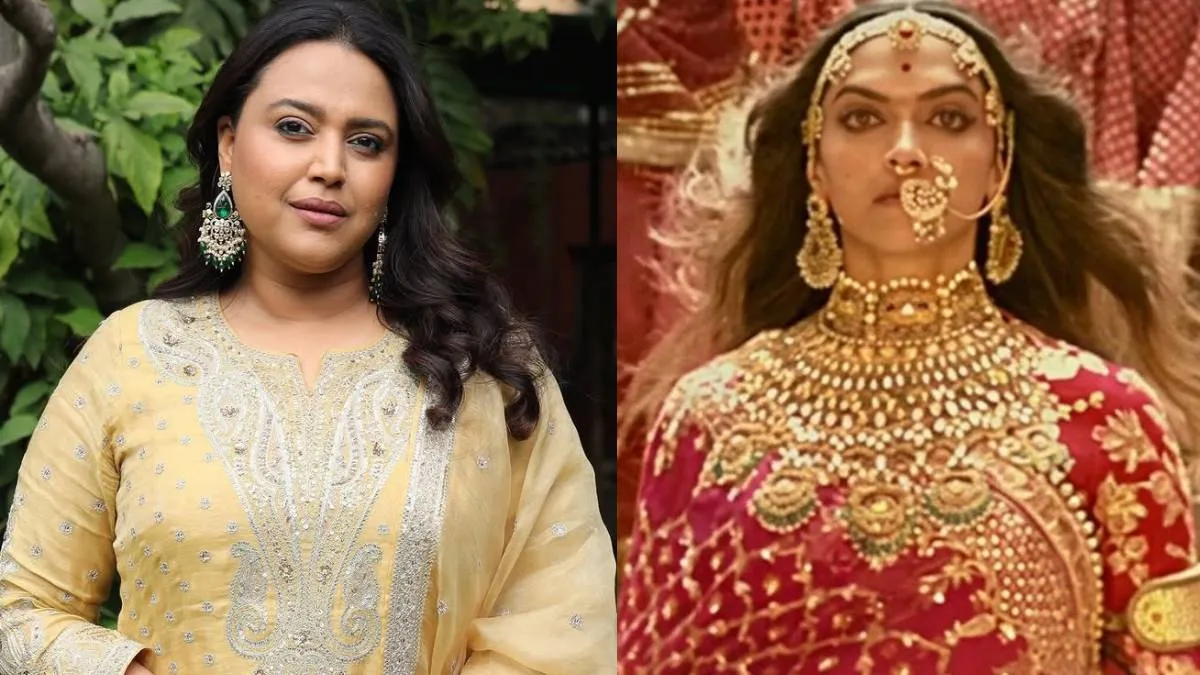
Swara Bhasker Responds to Backlash:Bollywood actress Swara Bhasker has once again found herself at the centre of an online debate over her views on the jauhar sequence shown in Sanjay Leela Bhansali’s Padmaavat. After facing criticism for calling the portrayal troubling, the actress has now responded through an Instagram Story, explaining what she believes is the central point of her argument.
Swara said the discussion, in her view, is ultimately about a rape survivor’s right to continue living after sexual violence. She questioned why such a basic idea appeared to upset so many people, including women.
Her latest response comes after her recent comments about Padmaavat brought an old debate surrounding the film back into public conversation.
Swara Questions the Message a Survivor Could Take From the Scene
Speaking at an event in Delhi, Swara discussed the film’s climactic sequence in which hundreds of women are shown committing jauhar.
Rather than focusing only on the historical setting of the scene, she questioned how such a portrayal could be interpreted by a survivor of sexual violence today.
Swara wondered whether a rape survivor watching the sequence could come away feeling that she had somehow failed to protect her honour because she chose to remain alive.
She argued that no survivor should be made to feel cowardly for choosing life after experiencing sexual violence.
One detail in the sequence particularly disturbed her. Swara pointed to the depiction of a pregnant woman participating in the jauhar and said the moment had stayed with her after watching the film.
Why Swara Waited Before Writing Her Open Letter
Swara’s criticism of Padmaavat is not new.
After the film’s release, she wrote an open letter addressed to director Sanjay Leela Bhansali in which she questioned aspects of the movie’s portrayal of women and jauhar.
The actress has now explained that the letter was not an immediate emotional reaction.
According to Swara, she waited for around five days after watching the film before writing it. She wanted to give herself enough time to process what she had seen and find out whether her discomfort with the sequence would remain.
It did.
She said the broader message behind her letter was that women should not be reduced to their sexuality or judged solely through ideas surrounding sexual honour. As she summarised her position, women are much more than their private parts.
Social Media Criticism Follows Her Comments
Swara’s renewed comments quickly attracted criticism on social media.
Some users argued that her interpretation did not adequately consider the historical circumstances associated with jauhar. Others accused her of disrespecting the women connected with the practice and the cultural memory surrounding it.
Some of the strongest criticism came from users who felt her remarks were insulting towards Hindu women, particularly Rajput women, and their understanding of honour and sacrifice.
The debate soon expanded beyond the film itself, with people arguing over history, sexual violence, individual choice and how events from the past should be represented in modern cinema.
Swara Clarifies Her Position on Instagram
Amid the backlash, Swara took to Instagram Stories to make her position clearer.
She wrote, “It’s wild how so many people (including women) get triggered by the basic point that a rape survivor has the right to live after rape!”
Her response suggests that she believes part of the criticism has moved away from what she was originally trying to say.
For Swara, the central issue is not whether historical women should be judged for the decisions they made under extreme circumstances. Her argument focuses instead on the idea that a survivor of rape should never be made to believe that continuing to live makes her less courageous or less worthy of respect.
‘Padmaavat’ Debate Returns Years Later
Directed by Sanjay Leela Bhansali, Padmaavat featured Deepika Padukone, Ranveer Singh and Shahid Kapoor in prominent roles. Its portrayal of jauhar became one of the most discussed aspects of the film following its release.
Swara was among the film industry personalities who publicly questioned the message she believed could be taken from the sequence.
Years later, that disagreement is once again generating strong reactions.
Her latest clarification also shows why the discussion remains sensitive. For some, the scene is viewed through the historical circumstances and sacrifice associated with jauhar. Swara, on the other hand, has repeatedly approached it from the perspective of what its imagery might communicate about women, sexual violence and survival.
With her latest Instagram Story, the actress has made one part of her position particularly clear: whatever the circumstances, she believes a survivor should never be made to feel ashamed for choosing to live.

